Where the electricity comes from after sunset
Panels produce nothing at night. What covers the evening is either the grid or a battery, and the two answers cost and behave differently.
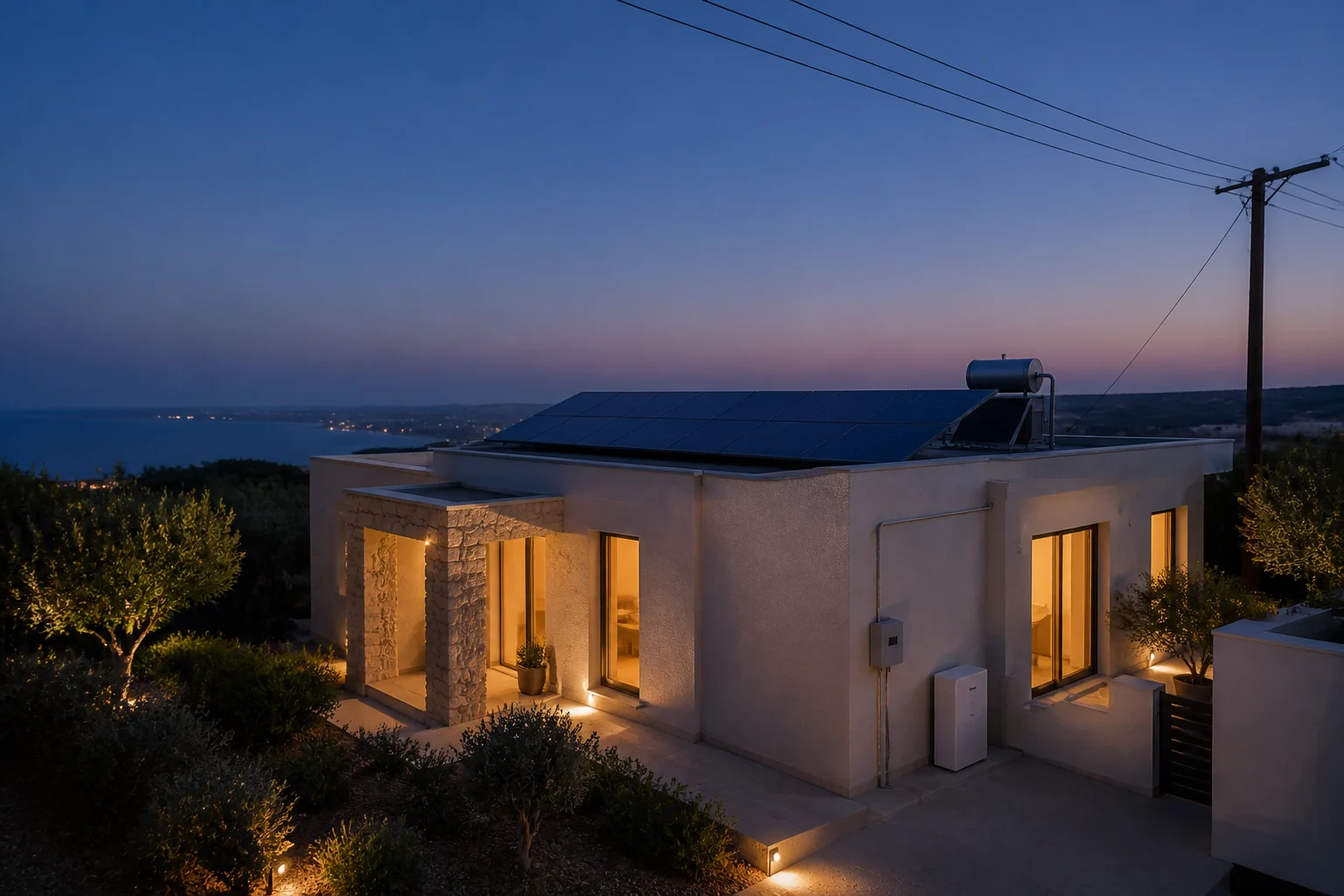
The article explains general patterns. Your roof, your equipment and your consumption differ, and the numbers for them come from a survey.
The panels are not generating
A panel produces when light falls on it and stops when the light goes. There is no storage inside a panel and no trickle of output after dark. So the evening — which for most households is the heaviest part of the day — is covered by something else.
The grid as the default answer
In a grid-connected system, the building draws from the network at night exactly as it did before the panels arrived. The system did not become independent; it became cheaper during daylight.
This is the arrangement most rooftop systems in Cyprus use, and it is the reason the sizing question in the previous article revolves around daytime consumption. Night demand is bought, not produced.
What varies between connection schemes is how the daytime surplus is treated — whether it offsets the night draw, and on what terms. That is a rules question, and it changes without anyone touching your roof.
A battery as the second answer
A battery stores daytime surplus and releases it in the evening. It shifts energy in time; it does not create any.
Two consequences follow from that sentence, and both get lost in sales conversations.
First, a battery only pays for the energy it actually cycles. If a household consumes most of its production as it is produced, there is little surplus left to store, and the battery spends the year half idle.
Second, a battery does not extend the system's total output. A roof that produces a given amount per year still produces that amount with a battery attached. The battery changes when you use it, and therefore what you avoid paying for.
What a battery does not automatically give you
Backup during a blackout is a separate function from storage, and not every battery installation provides it.
A standard grid-connected inverter shuts down when the network goes down. It has to: feeding a dead line endangers whoever is repairing it. Keeping the house alive during an outage requires equipment that can disconnect from the network and run the building as an island — that capability is specified, wired and paid for separately.
If backup matters to you, it belongs in the quote as its own line, not as an assumption.
Going fully off-grid
An off-grid system has no network to fall back on, which changes every number in the design. Storage has to cover the longest stretch of bad weather you are willing to tolerate, not an average evening. Generation has to be sized for the worst month, not the annual mean. Some loads — an electric water heater, a pool pump, a workshop — may have to be redesigned or given up.
Off-grid makes sense where connecting to the network is genuinely expensive or impossible: a remote plot, a long trench, no existing supply. As a way of avoiding an electricity bill at a site that already has a connection, it is usually the expensive route to the same place.
How to tell which one you need
Look at when you actually use electricity, not at how much. A household that is empty from eight to six has a different problem from one with someone home all day, and the same roof serves them differently.
The honest version of the question is: how much of my evening consumption am I willing to pay to move into daylight, and at what price per stored kilowatt-hour. Any installer proposing a battery should be able to answer that with your own consumption figures in front of them.