How a home solar system works in Cyprus
The parts of a rooftop system, where the electricity goes during the day, and which part of the answer depends on Cyprus rules rather than on hardware.
The article explains general patterns. Your roof, your equipment and your consumption differ, and the numbers for them come from a survey.
Most explanations of rooftop solar stop at "panels make electricity". That sentence is true and useless: it does not tell you what happens to a kilowatt-hour once it leaves the roof, and that is where the money is.
What the system is made of
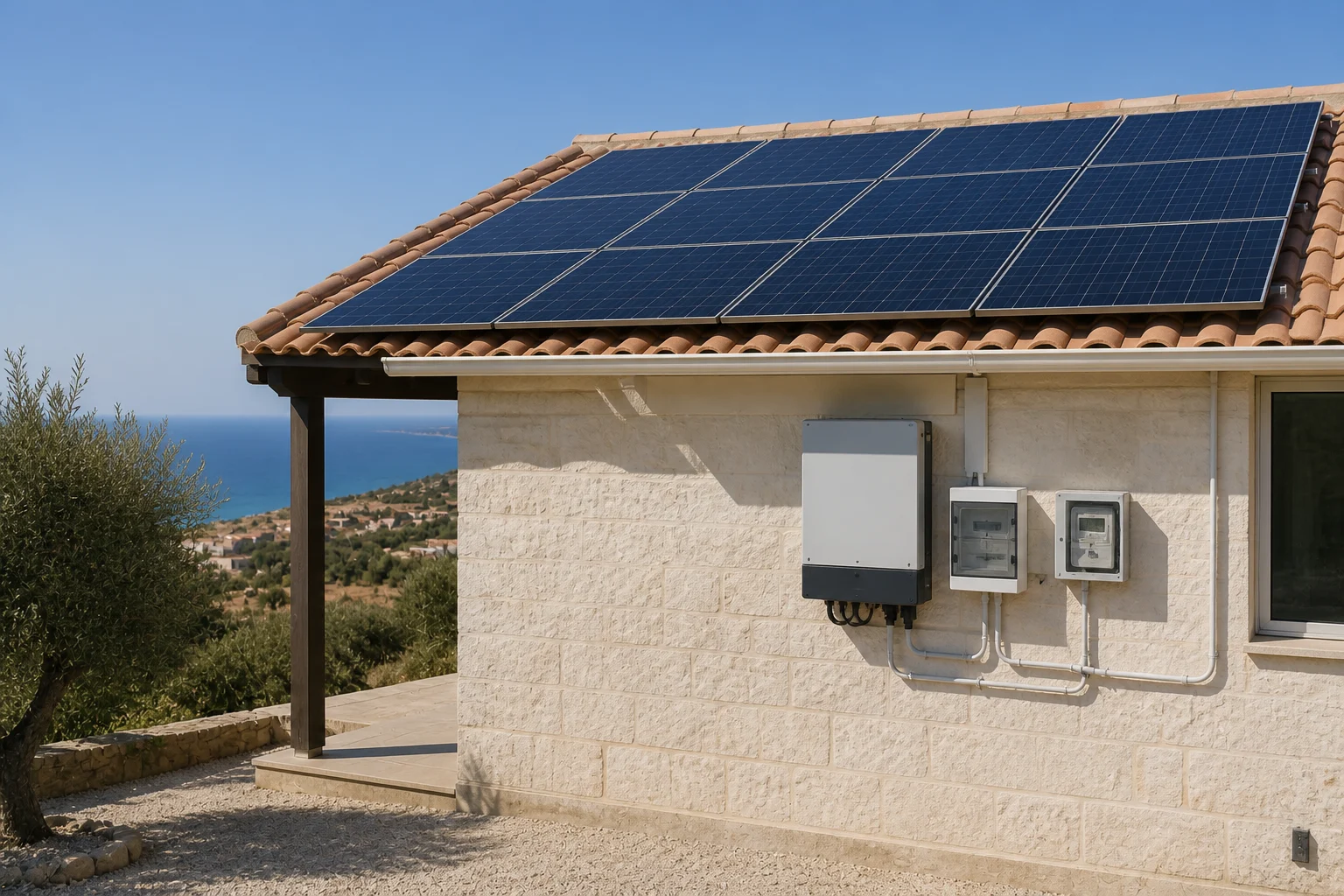
Four things do the work. Panels turn sunlight into direct current. An inverter converts it into the alternating current your sockets use, and it is the component that decides how the system behaves in every situation below. A meter records what crosses the boundary between the building and the grid. Mounting rails, cabling and protective gear hold the rest together and are the part people notice least and regret most.
A battery is a fifth part, and an optional one. A system without a battery is not incomplete — it simply behaves differently after dark.
Where the electricity goes during the day
Production goes first to whatever is switched on in the building at that moment: the fridge, the air conditioner, the pump. This is the cheapest kilowatt-hour the system will ever make, because it never crosses the meter and is never billed to you.
What the building cannot use at that moment has to go somewhere. Depending on how the system is connected, it flows out to the grid, charges a battery, or is simply not produced — the inverter throttles itself down.
The order matters more than the panel brand. Two identical roofs on the same street can produce the same amount and save different amounts, because one household runs its washing machine at noon and the other at nine in the evening.
Why sizing starts from your bill, not your roof
The roof sets a ceiling: it can only hold so many panels at a usable angle. But the ceiling is not the answer. The starting figure is your annual consumption and, more precisely, how much of it falls in daylight hours.
A system smaller than your daytime demand covers part of the bill and exports nothing. A system larger than your annual demand will produce surplus every sunny month, and what that surplus is worth is not a hardware question. It is set by the connection scheme and by whoever regulates it — which is a separate subject from this section.
What Cyprus changes in the picture
Two things, pulling in opposite directions.
There is more sunlight here than in most of Europe, so the same panel returns more energy per year than it would in Germany or Poland. That part is well known.
The part that surprises people is heat. Panel output falls as the cells get hotter, and cell temperature runs well above air temperature on a still summer afternoon. The best production day is not the hottest one in August — it is a clear, cool, breezy day in spring. This is also why the space under the panels and the way they are mounted is not a cosmetic detail.
What to ask an installer
Four questions separate a quote you can compare from a number on a page:
- what share of production the calculation assumes you will consume yourself, and where that share came from
- what happens to the surplus under the connection scheme being proposed
- what the system does when the grid goes down
- what the warranty covers separately for panels, for the inverter, and for the installation work
If the answer to the first question is a round number with no explanation behind it, the rest of the calculation is decoration.