Dust, desert outbreaks and what cleaning is for
Dust costs output every year on this island. What rain takes off, what it leaves bonded to the glass, and why a fixed cleaning schedule is a guess.
The article explains general patterns. Your roof, your equipment and your consumption differ, and the numbers for them come from a survey.
Everything that lands on the glass takes a share of the light before it reaches the cells. That much is obvious. What is less obvious is that the dirt on a Cyprus roof is two different substances with two different fates, and only one of them washes off.
The industry word for it
The losses caused by anything settling on a module are called soiling. The IEA Photovoltaic Power Systems Programme puts it second only to irradiance among the factors that decide a system's yield, and estimates the global cost at 3–5% of annual PV energy production.
That is a world average across every climate, including wet ones. It is a floor for a dry island, not a forecast.
Where the dust comes from here
Two sources, and they behave differently.
There is ordinary local dust: construction, unpaved roads, agriculture, sea spray, pollen. It accumulates continuously and its rate depends entirely on what stands immediately around your roof.
And there is desert dust arriving on the wind. The Cyprus Institute describes island residents as often witnessing dust conditions because of the proximity to desert regions in the Sahara and the Middle East, and lists solar energy applications among the things dust affects. During an episode in June 2024 the Copernicus Atmosphere Monitoring Service forecast daily maximum PM10 above 100 micrograms per cubic metre in areas including Cyprus.
Episodes are events, not weather. They deposit a lot in a short time and then stop.
Two kinds of dirt
This is the distinction the rest of the article rests on.
Loose deposit sits on the surface and is held there by gravity and weak surface forces. Rain removes it. So does a steep enough angle, some of the time — soiling losses generally fall as tilt increases, and are lowest on a vertical surface.
Bonded film is what loose deposit becomes once water gets involved without arriving in quantity. Under dew or high humidity the soluble fractions of the dust dissolve; as the surface dries, the dissolved material crystallises back out as solid bridges between the particles and the glass. The report describes this as cementation, alongside caking and capillary aging — separate mechanisms with the same result, which is that adhesion increases sharply.
A dry island with heavy nightly dew is close to ideal conditions for turning yesterday's dust into a layer that this winter's rain will not lift.
Why rain is not a plan
Rain does clean, and where it is frequent enough it makes cleaning uneconomic. Studies quoted in the report find that in parts of mid and northern Europe cleaning modules does not pay for itself because rainfall is high and soiling rates are low, while in southern Europe it makes economic sense.
Some soiling models simply reset accumulated soiling to zero on any day with more than a millimetre of rain. That is a modelling convenience, and it holds for loose deposit. It does not describe a bonded film, and it says nothing about the months on end when no such day arrives.
A light shower during a dust episode is the worst of both worlds: enough water to bond the layer, not enough to carry it away.
Cleaning without paying for it twice
Cleaning is corrective, and the corrective method has to suit what is actually on the glass.
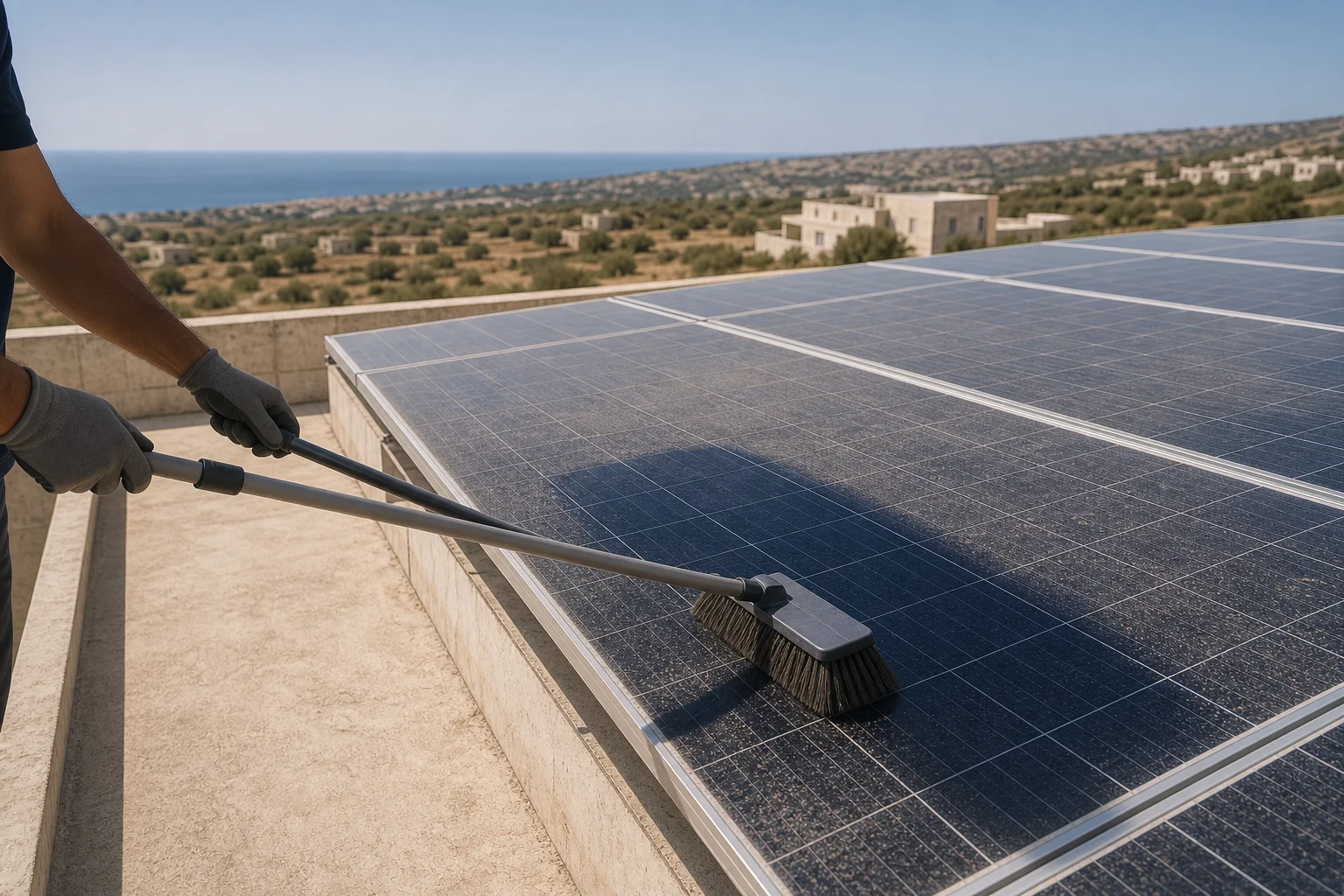
Professional systems use rotating brushes with demineralised water. Both halves of that matter. The report notes that dry brushing has in some cases caused considerable damage because the contamination itself is abrasive — you are dragging grit across the surface — and that scratches on the glass reduce its optical properties permanently.
So the wrong cleaning costs more than the dirt did. The general habits around working on a roof are covered in the article on lifespan and care in this section; what belongs here is the point that frequency is not a rule anyone can hand you. Rates vary enormously between sites, and the only honest input is production data from your own array.
What to ask an installer
- what soiling loss the production estimate assumed for this address, and what that assumption was based on
- how the proposed monitoring would let you tell a soiling loss apart from a fault
- what happens to dust and standing water at the tilt angle being proposed
- what cleaning method they would use, what water, and what they would refuse to do to the glass
- who is responsible for cleaning under the offer, and what changes if nobody does it