Cyprus roofs and the solar water heater
Flat concrete with waterproofing, tile, and a hot water tank already up there. Which questions belong to the roof and which belong to the installer.
The article explains general patterns. Your roof, your equipment and your consumption differ, and the numbers for them come from a survey.
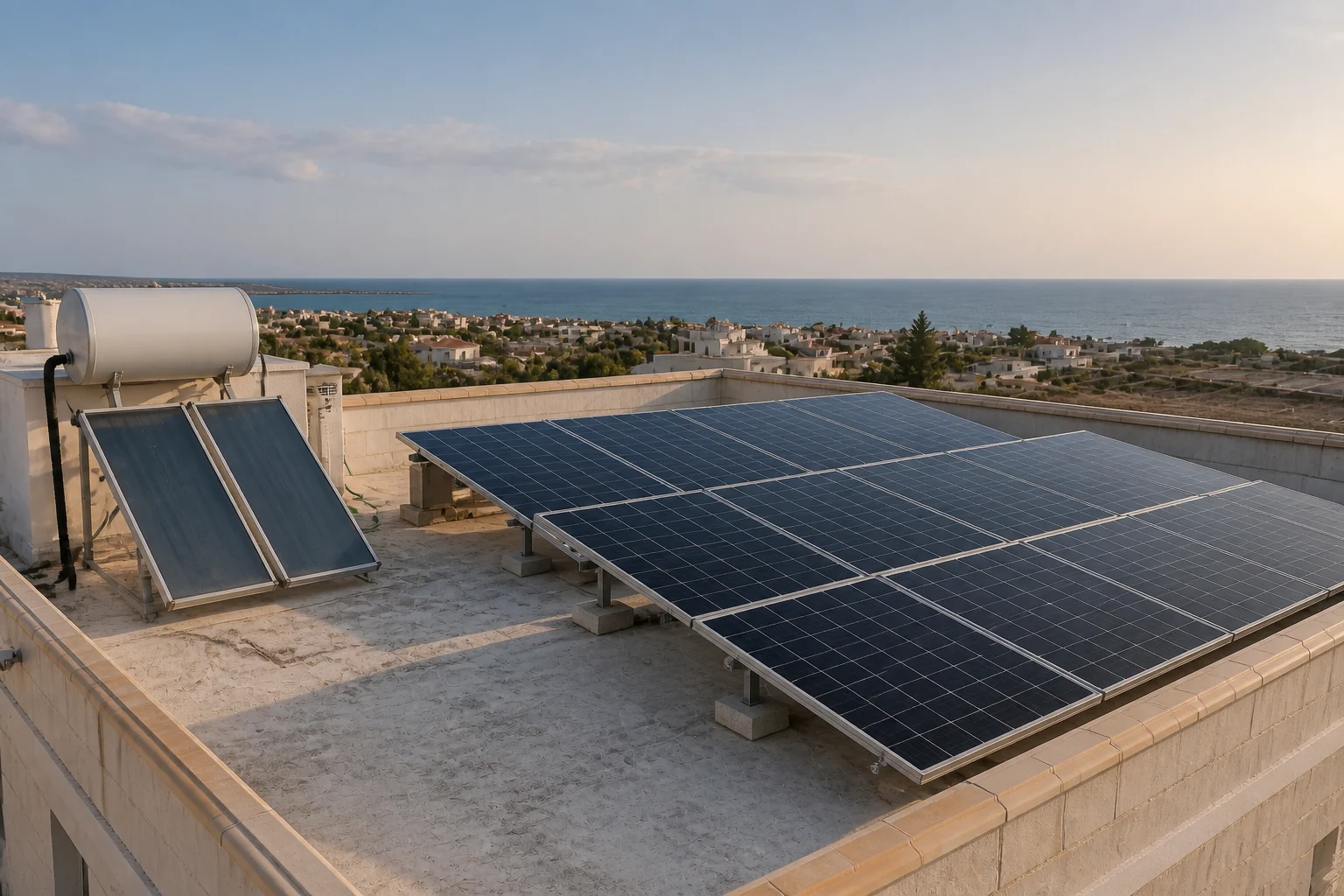
A rooftop system is bolted to a building that already exists and was designed for something else. On this island that building is usually a flat concrete slab with a waterproofing layer on top, and there is usually already a hot water tank standing on it.
Everything in this article splits into two piles: things that are a property of your roof, which no installer can change, and things that are a decision the installer makes. Keeping them apart is what stops a site visit turning into a negotiation about who pays for a leak.
The flat concrete roof
The flat roof is the common case and the easier one in almost every respect. It has open area, it is walkable, and the array can be aimed rather than accepting whatever direction the building faces.
Its costs are three.
Panels on a flat roof have to be tilted up on frames to reach a useful angle, and tilted rows shade each other unless they are spaced — which is the trade-off covered in the article on tilt and orientation.
A near-flat panel is also a dust trap. Soiling losses generally fall as tilt increases, so the flattest arrangement is the one that keeps the most dirt and holds standing water longest.
And the frames and any ballast are new weight on a slab that was designed without them. Loads on structures in Europe are set out in the Eurocodes: self-weight and imposed loads in EN 1991-1-1, wind in Part 1-4. Whether the existing structure carries the addition is a question about the building, answered by someone qualified to answer it, not by whoever is quoting for the panels.
The waterproofing layer is the part that leaks
Under the tiles or screed of a flat Cyprus roof there is a membrane, and it is the only thing between the slab and the weather.
Every fixing driven through it is a deliberate hole in the one layer whose job is to have no holes. Done properly, with the right detail and sealing, penetrations are entirely normal and last. Done casually, they leak — not immediately, which is the problem, but two winters later, into a room, with the array sitting on top of the evidence.
The alternative is a ballasted system that sits on the roof under its own weight and never pierces the membrane. That trades the leak risk for weight and for a stricter wind calculation, since nothing anchors it but mass.
Neither approach is correct in general. What is not acceptable is the question going unanswered: the age and condition of the waterproofing, and what happens to it, belong in the quote in writing.
Tiled roofs
Pitched tiled roofs bring a different set. The angle and direction are fixed, so the geometry is whatever the building gives you. Mounting means lifting tiles and fixing brackets to the rafters underneath, which is skilled work and the point at which a roof can be damaged invisibly.
They do have advantages. The angle is usually already reasonable, air moves behind panels mounted on standoffs, and rain runs off rather than pooling.
The honest summary is that a tiled roof is less flexible and more dependent on the installer's care, and that a cracked tile discovered in December was made in July.
The tank that is already there
Cyprus roofs are crowded because Cyprus heats its water with the sun. In the IEA's global survey, at the end of 2022 the island ranked second in the world for installed water collector capacity per thousand inhabitants — 478 kilowatts of thermal capacity per thousand people, against 597 for the leading country — and first in the world for newly installed glazed collector capacity per thousand inhabitants.
So the practical question is almost never whether to have solar water heating. It is what to do about the one that is already installed.
A tank on a stand is a tall object on an otherwise empty roof, and tall objects cast long shadows in winter. It also occupies the area a designer would most like to use. The options are all ordinary — move the array, move the tank, accept the loss, or replace the thermal system as part of the work — but they have different prices and one of them has to be chosen on purpose.
The mistake is treating the tank as furniture. It is part of the site survey.
What to ask an installer
- who assesses whether the structure carries the additional load, what they produce, and whether the client receives a copy
- how the mounting attaches to this roof, and what is done where anything passes through the waterproofing
- what the shading survey found for the water tank in December rather than in June
- what happens to the existing solar water heater under this proposal, and what that costs
- what the installer is liable for if water appears below the array, and how long that liability runs